
Repost: Research All the Things
/
I’m not sure if I’m overly obsessed with research or whether I’m just really good at choosing locations and subjects for my books about which I know virtually nothing.
Read MoreI’m not sure if I’m overly obsessed with research or whether I’m just really good at choosing locations and subjects for my books about which I know virtually nothing.
Read MoreToday I'm blogging at Layers of Thought about creating angels. Stop by for a chance to win an ebook of The Fallen Queen.
Note: I found this interpretation of a seraph online. Mine are a bit less...benevolent. ;)
Well, according to me, it looks like this:
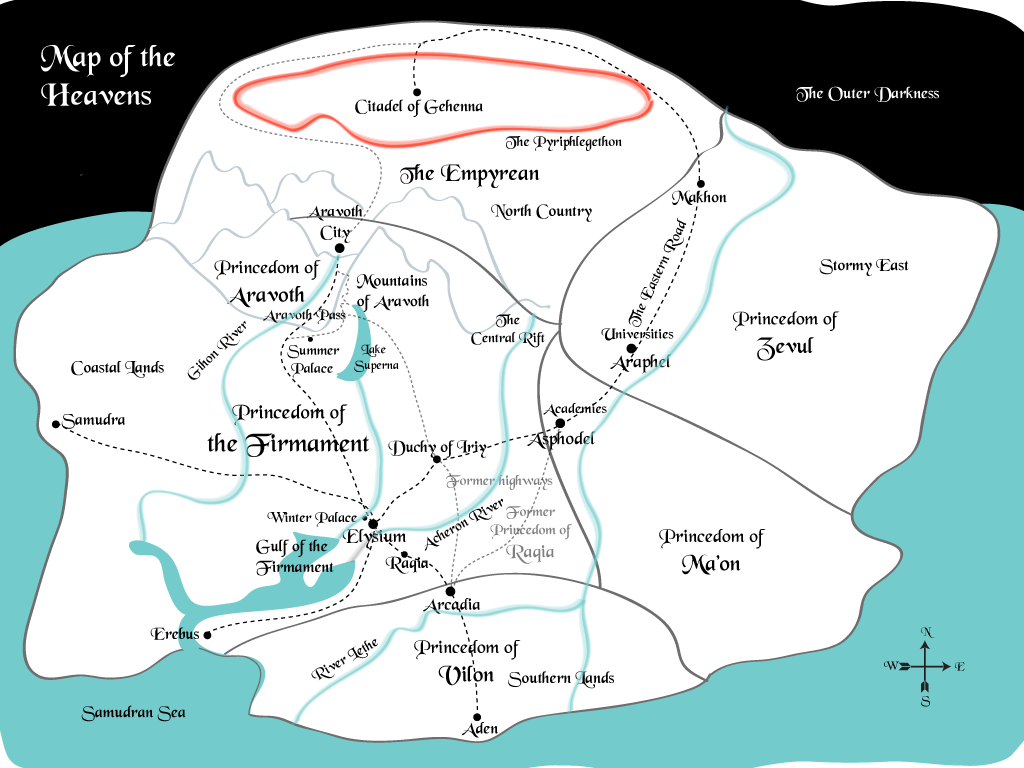 Click map to enlarge
A black and white version appears in the book, but I thought readers might enjoy seeing the original on a single page.
If you've read The Fallen Queen, you'll notice there are many places on the map not visited in the book. You'll see much more of the Heavens in Book Two, The Midnight Court.
Copyright © 2011 by Jane Kindred
So an interesting thing developed while I was writing the Queen of Heaven series. The beginning of The House of Arkhangel'sk opens on a card game. It was one of the first images I had of this world: a den of "iniquity" in heaven, where an angel of the ruling House of Arkhangel'sk, disguised as a local in heaven's ghetto, played cards with a demon. I thought my demons should have a deck of cards more suited to heaven than earth, so I invented one that used the angelic orders in four suits for the cardinal elements, and called the game "wingcasting." (Don't ask me where the name came from. It's lost in the primordial soup of the book's beginnings. All I remember is that I was looking for Victorian card games, and something put this combination of words into my head, and it stuck.)
The game is played much like poker, but to make it more complicated, I added a twelve-sided die with a different animal representing one of the four cardinal elements on each face. The play of each hand is preceded by a cast of the die, giving one's opponent the opportunity to call out a symbol before it lands. If that symbol appears on the face, the casting player must surrender a card. If it doesn't, the opponent must increase his bet to continue to play.
This was all well and good, and deliciously impossible to win. My naughty demon Belphagor became a master player—through both skill and tricks—and beat the pants off my little angel. (Or rather, beat the pants onto her...well, you'll have to read it.)
Little did I know, there were other demons hanging around the slums of Raqia who used the cards for something else entirely. One demon in particular likes to keep things from me until she springs them on me at the last minute out of the blue, and she was busy turning this harmless little deck of cards into a much more useful tool. Thus the divination system called the Chora (for the choirs of angels depicted on the cards) was born. More than just a device for fortune-telling, it became a means of communicating between the spheres, when such practicalities as the Internet and cell phones could not be had in my late-Victorian Heaven.
Why am I telling you all this? Heavens, I don't know. You're the one who came to the blog; don't blame it on me. What do you want, pictures of half-naked tattooed men every day? Well...okay, then!
Oh, and I'll be blogging over at Here Be Magic tomorrow about plotting with the tarot.
Jane Kindred is the author of the Harlequin Nocturne series Sisters in Sin and epic fantasy series The House of Arkhangel’sk, Demons of Elysium, and Looking Glass Gods. She spent her formative years ruining her eyes reading romance novels in the Tucson sun and watching Star Trek marathons in the dark. After spending the next 30 years writing to the sound of San Francisco foghorns while two cats slowly but surely edged her off the side of the bed, she was ultimately drawn back to the desert—where she has now acquired yet more cats in an attempt to rival Nikola Tesla demonstrating a faulty teleporter prototype.
Jane also writes erotica as Betty Blue.
Powered by Squarespace